
“Come, everyone who thirsts, come to the waters; and he who has no money, come, buy and eat!”
— Isaiah 55:1 (ESV)
There is a chapter in the Bible that reads like the heart of God laid open.
It opens with a street merchant’s cry at a bustling marketplace. It ends with trees clapping their hands. And in between, it contains some of the most staggering promises, urgent invitations, and beautiful descriptions of divine grace found anywhere in Scripture.
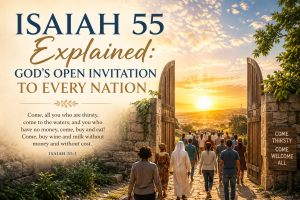
That chapter is Isaiah 55.
For missionaries, cross-cultural workers, church planters, and anyone who believes the Gospel is for every people on earth, Isaiah 55 is more than a beautiful passage. It is a theological manifesto declaring that God’s grace extends to all who thirst, His Word never returns empty, and His redemptive purposes will ultimately reverse the curse itself.
Why Isaiah 55 Matters for World Mission
Isaiah 55 closes a major section of Isaiah often called the Book of Consolation (Isaiah 40–55). Israel faced exile, loss, and uncertainty. Yet instead of offering political solutions, God extends an invitation to a feast.
Even more remarkable, this invitation is not limited to Israel.
“Behold, you shall call a nation that you do not know, and a nation that did not know you shall run to you.” (Isaiah 55:5)
This is a missionary text. Nations beyond Israel are invited into God’s covenant blessings.
Verse 1 — The God Who Shouts in the Marketplace
“Come, everyone who thirsts, come to the waters; and he who has no money, come, buy and eat!”
The chapter opens with the Hebrew word hoy, a marketplace cry used by merchants. God is not whispering from a distance. He is calling publicly and urgently.
The invitation is for everyone who thirsts. There are no ethnic, social, or religious barriers. Thirst is the only requirement.
The paradox is striking: “buy without money and without price.” Grace cannot be purchased because the price has already been paid. Isaiah 53 points us to the Suffering Servant who bore our sins so that salvation could be offered freely.
The wine and milk symbolize joy, abundance, nourishment, and covenant blessing. God offers more than survival. He offers a feast.
Verse 2 — The Question That Diagnoses Humanity
“Why do you spend your money for that which is not bread, and your labor for that which does not satisfy?”
This question speaks to every generation. Humanity continually pursues things that promise fulfillment but leave the soul empty.
God invites people to stop striving for substitutes and instead receive true satisfaction from Him.
The command to listen diligently means more than hearing words. It means paying attention with the whole heart and responding in obedience.
Verse 3 — The Everlasting Covenant
“Incline your ear, and come to me; hear, that your soul may live; and I will make with you an everlasting covenant.”
The invitation is literally a matter of life and death.
God promises an everlasting covenant, a permanent commitment rooted in His faithfulness. The blessings once associated with David’s royal line are now extended to all who respond to God’s invitation.
The New Testament confirms this fulfillment through Jesus Christ, the risen Son of David.
Verses 4–5 — The Nations Will Run to God
“Behold, I made him a witness to the peoples, a leader and commander for the peoples.”
These verses describe the Messiah as:
- Witness — revealing God to humanity
- Leader — ruling with divine authority
- Commander — calling people into obedience
The result is extraordinary:
“A nation that did not know you shall run to you.”
The nations respond because the Messiah has been glorified. The missionary movement of the Church flows directly from the exaltation of Jesus Christ.
Verses 6–7 — The Urgency of Repentance
“Seek the LORD while he may be found; call upon him while he is near.”
These verses emphasize urgency. God’s invitation is open, but people must respond.
True repentance involves both:
- Forsaking sinful actions
- Forsaking sinful thinking
The promise is stunning:
“He will abundantly pardon.”
God’s forgiveness is not reluctant or minimal. It is abundant, overflowing, and greater than human expectations.
Verses 8–9 — God’s Ways Are Higher
“For my thoughts are not your thoughts, neither are your ways my ways.”
These verses are often quoted as a statement about divine mystery, but in context they explain God’s abundant forgiveness.
Human forgiveness is limited and conditional. God’s forgiveness is immeasurably greater because His ways are higher than ours.
The Gospel itself demonstrates this reality. Humanity could never invent a salvation so gracious and complete.
Verses 10–11 — The Word That Never Fails
“So shall my word be that goes out from my mouth; it shall not return to me empty.”
Rain and snow accomplish their purpose by nourishing the earth. God’s Word accomplishes its purpose by transforming lives.
According to Isaiah 55, God’s Word:
- Waters the earth
- Produces growth
- Provides seed for future sowing
- Provides bread for nourishment
For missionaries and church planters, this is a foundation for perseverance. Results may not always be visible, but God’s Word never fails to accomplish His purposes.
Verse 12 — Going Out with Joy
“For you shall go out in joy and be led forth in peace.”
This language echoes the Exodus but points toward a greater redemption.
Creation itself rejoices:
- Mountains sing
- Hills rejoice
- Trees clap their hands
The Gospel affects more than individuals. It points toward the restoration of all creation.
Verse 13 — The Trees That Declare His Glory
“Instead of the thorn shall come up the cypress tree, and instead of the brier shall come up the myrtle tree.”
Thorns symbolize the curse introduced in Genesis 3. They remind humanity of sin’s consequences.
The cypress and myrtle symbolize restoration, blessing, beauty, and life.
This transformation points directly to Jesus Christ, who wore a crown of thorns so that the curse could be removed.
The replacement of thorn and brier with cypress and myrtle represents God’s promise to reverse the effects of sin and renew creation.
The purpose of this transformation is clear:
“It shall make a name for the LORD, and be an everlasting sign that shall not be cut off.”
Everything in Isaiah 55 ultimately exists for the glory of God’s name among the nations.
What Isaiah 55 Means for Your Ministry Today
- The invitation is already open. God’s call extends to every nation and every people group.
- Grace cannot be earned. Salvation is free because Christ paid the price.
- God’s Word will accomplish its purpose. Faithful proclamation is never wasted.
- The curse is being reversed. Wherever the Gospel advances, transformation follows.
- God’s work among the nations is unstoppable. What He begins, He completes.
Isaiah 55 remains one of the greatest missionary passages in Scripture. It calls us to proclaim God’s invitation boldly, trust His Word completely, and labor with confidence that His purposes will prevail.
One day the mountains will sing, the hills will rejoice, and the trees will clap their hands as the name of the Lord is known among every nation on earth.
Related Posts:
- How to Study the Bible for Cross-Cultural Preaching
- The 10/40 Window Explained: Where Are the Unreached Peoples?
- Missionary Training: What Every Church Planter Must Know Before Going
- The Suffering Servant of Isaiah 53 and the Heart of Mission